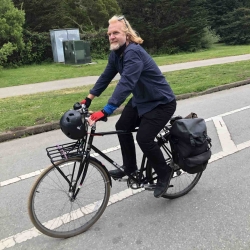
Jason Henderson
Biography (updated Jan 2026)
Jason Henderson is Professor of Geography in the School of the Environment (SotE) at San Francisco State University. His research focuses on the ‘politics of mobility’ and examines how culture, history, geography, politics, and economics shape transportation. Jason’s research and teaching are motivated by the need for rapid and accelerated de-car (bonization) to limit global warming, and inspired by efforts to build compact, car free and cycling cities around the world.
The main threads of research and teaching are:
- “Street Fights in the Anthropocene,” which examines the politics of mobility and future narratives about mobility; Debates about expanding global automobility; Electrified robotaxi ‘tech mobilities;’ ‘Green mobility’ cities and reducing car dependency; Revanchist “mean mobilities” such as mobility as an instrument of spatial secession, vehicular violence, global resource extraction politics. Currently working on a book-length manuscript, the work builds on Henderson, J. (2020). EVs are Not the Answer: A mobility Justice Critique of Electric Vehicle Transitions Annals of the American Association of Geographers.
- History and the Politics of Mobility derives from a year-long research sabbatical in Paris (2023-2024). It will examine such themes as the evolution of traffic calming from ancient Rome to road fights in the 20th and 21st Century; Histories of debates over tolling and contemporary debates about congestion pricing; The role of transport in historical urban revolutions; Historical politics of mobility of streetcars, metros, and railways; Bicycle politics from the 19th century to 2000’s; Historical evolution of a green politics of mobility along with concepts of climate and mobility justice.
- The Politics of Mobility in San Francisco and the US: This thread builds on previous work in Street Fight: The Politics of Mobility in San Francisco (2013). It looks at Pandemic and post-Pandemic era car free spaces and political backlash; historical politics of street configurations in SF, ballot-box planning and mobility in San Francisco, the role of tech elites in San Francisco’s politics of mobility.
- What is Social Democratic Mobility? This research examines how socialist and social democratic thinkers and organizations have conceptualized transportation, from early thinking about ownership of railways, planning in Soviet cities, to contemporary debates about funding public transportation and privatization of mobility. It builds on my research in Copenhagen, Denmark, which culminated in Street Fights in Copenhagen: The Politics of Mobility in a Green Mobility City (co-authored with Prof Natalie Gulsrud).
- Polar Politics of Mobility considers how future climate migration towards polar regions might unfold and what the politics of mobility might look like. Currently in early stage/ literature review.
- Historical Geography and Future Geography of New Orleans. Considers how New Orleans and the catastrophe of Hurricane Katrina unfolded from political decisions, and the implications of the post-Katrina rebuild debate have had on broader US climate and urban policy.
- Other research overlapping interests: History and politics of car free/ car lite spaces in cities, political history of bicycle advocacy and policies around the world, transport politics in Paris, history and politics of high-speed rail.
Teaching (most recent listed first):
GEOG 820: Graduate Seminar in Human Geography (Spring 2026) examines competing narratives about future mobility and cities, the scramble for planetary resources and how that relates to mobility, climate justice and mobility, and ideas to de-car (bonize) mobility.
Geography of Urban Transportation (Geog 433) (Spring 2026): de-car (bonizing) transport, green mobility, bicycles, public transit (Muni/BART/ Passenger Rail), transportation finance (taxes/tolls), public versus private transport; Emphasis on San Francisco Bay Area and California. Includes field trips.
ENVS 450: Environmental Law & Policy (Spring 2026): Topics include the historical evolution of US
environmental policy; concepts of wilderness and conservation; Global warming politics and policy;
Environmental laws such as the National Environmental Policy Act (NEPA); California Environmental
Quality Act (CEQA) Clean Air Act (CAA) Clean Water Act (CWA); Endangered Species Act (ESA); and
US environmental policy and politics in the Arctic and Antarctic regions in an era of global warming.
Comparative Global Transportation (Geog 435) (Fall 2025): Case studies of mobility in cities and around the world; What can San Francisco learn from other cities and metropolitan regions? Car ownership, bicycles, rail and bus transit, parking, finance, political culture, green mobility and de- car (bonization).
Other courses:
Intro to Human Geography (Geog 102): Geography and global warming, globalization of the economy, global urbanization patterns, population and resources; transport geographies.
Bicycle Geographies (Geog 437): Why bicycle? What are opportunities for increased cycling? How can SF State and the Bay Area increase cycling? History, debates, planning, politics, culture, and bicycle field trips!
Land Use Planning (Geog 658): Urban planning and global warming, sprawl and density, environmental review, parking, zoning, planning process. How compact cities can contribute to rapid and accelerated decarbonization.