Dam-It: Using LiDAR and Machine Learning to Uncover Fish Passage Barriers
Abstract
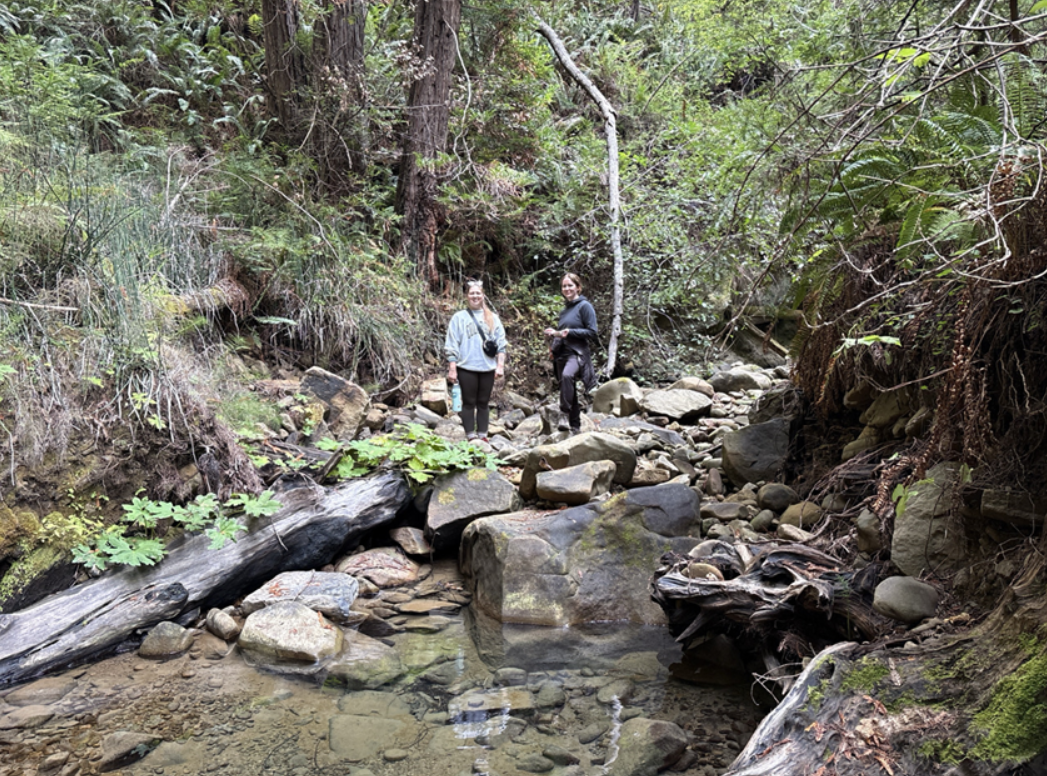
Fragmentation of stream networks by dams, culverts, and other human-made structures is a major factor contributing to the decline of anadromous salmonids in California. Reliable, spatially explicit barrier inventories are critical for restoration planning, yet field surveys remain prohibitively costly at regional scales. This study developed a reproducible, LiDAR-based and machine-learning approach to predict fish passage barriers across Sonoma County, California. Using 1-meter USGS Digital Elevation Models (DEMs), longitudinal profile metrics, and contextual hydrographic variables, a Random Forest classifier was trained on 174 known barrier and non-barrier sites from the California Fish Passage Assessment Database (PAD). Model performance was high for total barriers (accuracy = 86.4%, macro-F1 = 0.84) and moderate for mixed barrier types (accuracy = 74.2%, macro-F1 = 0.74). Downstream slope and elevation variability were the most influential predictors, indicating that abrupt geomorphic discontinuities are strong indicators of complete passage obstructions. A Sonoma Coast localized model validation on Miller Creek and Fort Ross Creek tested the model’s transferability using 10 m stream index points and aggregation of contiguous positive predictions into candidate reaches. Although one high-probability cluster coincided with a natural total barrier located about 12 m (39 ft) from the predicted centroid, field observations indicated this match was likely coincidental. The 1.3 km run of high probabilities reflected repeated sampling of steep valley walls and NHD flowline misalignment rather than a continuous obstruction. Other moderate- probability reaches corresponded to minor step-pool or low-flow constrictions that did not meet formal barrier criteria, illustrating model sensitivity to sub-barrier geomorphic settings. Overall, the localized model validation demonstrated that LiDAR-derived terrain metrics and Random Forest classification can localize barrier-prone reaches but require DEM-aligned streamlines and finer segmentation (< 300 m) to avoid over-aggregation and improve transferability in rugged headwater basins.