Vulnerabilities to Dry Wells: Socioeconomic Disparities in the San Joaquin Valley
Abstract
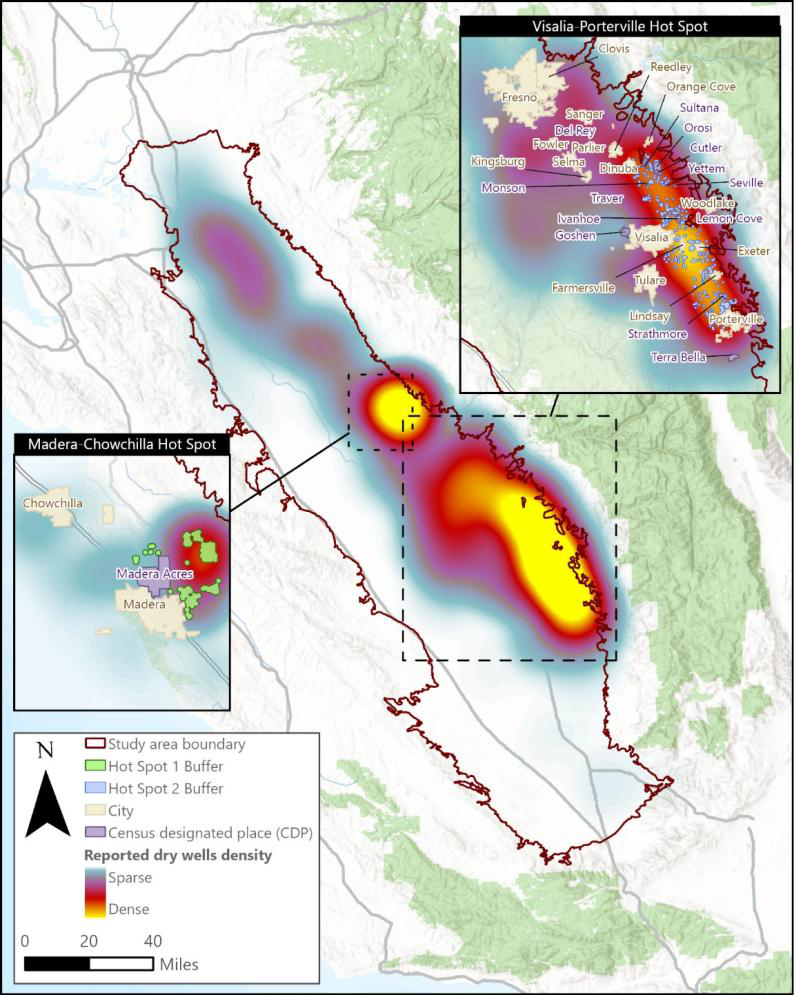
Groundwater depletion in California’s San Joaquin Valley has contributed to widespread domestic well failures, raising concerns about environmental justice and equitable implementation of the Sustainable Groundwater Management Act (SGMA). This study examined the demographic profile of communities living near reported dry wells in SGMA-designated high-priority basins. Census block group data from 2023 were spatially allocated using address points to estimate race and poverty within dry-well buffer areas. Buffer populations were compared across three incorporated place-based reference populations using a multi-scale framework and hot spot identification. Results showed that demographic patterns remained generally consistent across spatial scales, indicating that racial composition near reported dry wells was not highly sensitive to geographic scale. Hispanic or Latino residents comprised more than half of the population living near reported dry wells but were not proportionally overrepresented relative to incorporated place-based reference populations. White residents were consistently overrepresented within buffer areas, while Black and Asian residents were underrepresented, and poverty rates were comparable to reference populations. Weighting by dry-well distribution refined interpretation by emphasizing where wells were most numerically concentrated. Hot spot analysis identified the Madera–Chowchilla area as a priority location for targeted mitigation and resource allocation.